Card Storage and Maintenance Guide: Starting with Humidity and Light
Utilizing Sleeves, Top Loaders, Binders, and Storing Opened Boxes
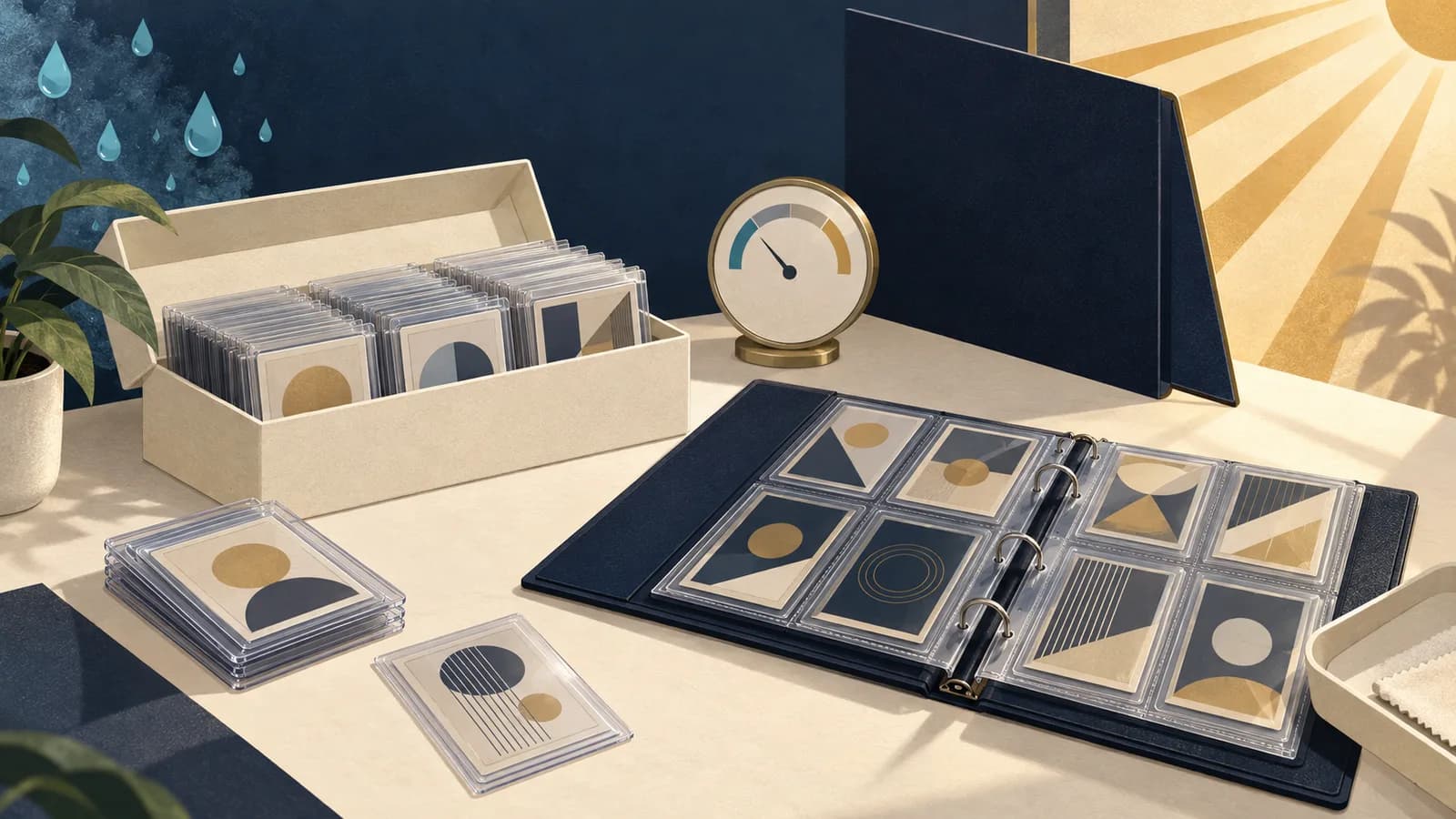
Trading cards are, ultimately, paper products. The Northeast Document Conservation Center (NEDCC), a non-profit preservation institution in the United States, identifies temperature, relative humidity, light, and air quality as the four environmental factors that determine the lifespan of a collection. Following these basics is more important than buying expensive protective supplies.
Humidity and Temperature: 'Stability' Over Specific Values
According to the NEDCC, paper is a material that easily absorbs and releases moisture; it expands when humidity is high and shrinks when it is low. If these changes occur rapidly and repeatedly, the shape becomes warped. High humidity increases the risk of mold and pests, while excessively low humidity makes the paper lose flexibility and become brittle. According to research cited by the NEDCC, materials adjust to temperature changes within hours, but respond to humidity changes over days or even months. The NEDCC suggests a standard for paper materials in shared storage spaces of 68°F ± 4°F (approx. 18–22°C) and a relative humidity of 30–60%. At home, it is advisable to check conditions with a thermo-hygrometer and avoid windows, outer walls, or areas near bathrooms where temperature and humidity fluctuate significantly.
Light: Damage is Cumulative and Irreversible
Light causes colors to fade, and ultraviolet (UV) rays weaken paper and cause yellowing. The NEDCC emphasizes that light damage is cumulative and irreversible. Even for cards on display, avoid windows with direct sunlight; for stored cards, it is safer to keep them in boxes to block light. The NEDCC recommends turning off lights when not in use, using UV-blocking films or shades on windows, and avoiding the top of shelves or areas directly against windows.
Utilizing Sleeves, Top Loaders, and Binders
- Sleeves: These are the primary shield against scratches and fingerprints. For gaming, as recommended by official tournament rulebooks, sleeves with opaque backs help reduce the exposure of flaws on the card back.
- Top Loaders (Rigid Holders): These provide an extra layer of protection for cards already in sleeves to prevent bending and pressure. They are suitable for high-value cards or those intended for grading.
- Binders: While great for viewing many cards at once, cards can be crushed if forced into pockets or if heavy objects are placed on top of a flat-lying binder. It is better to store them vertically.
- Writing Caution: Do not write on paper placed on top of a card. PSA considers indentations from writing as a defect subject to a 'Marks' (MK) qualifier.
Opened Boxes and Unopened Products
Keep remaining packs and accessories from opened boxes in their original packaging to prevent them from being crushed, and store them in a place with low humidity and minimal temperature changes. The same environmental principles apply to unopened boxes since they also use paper packaging. When stacking multiple boxes, adjust the height to ensure the bottom boxes are not crushed.
Sources
- NEDCC · Temperature, Relative Humidity, Light, and Air Quality (Accessed 2026-09-14)
- Play! Pokémon · TCG Tournament Handbook (2026-05-21)
- PSA · Grading Standards (Accessed 2026-09-14)
This article was written by an AI reporter based on public sources and published after review by the editor. AI principles →
This article was machine-translated from Korean with AI. Original →