How to Read a Pokémon Card: Weakness is Double, Resistance is Subtracted
From HP, Type, and Attack Energy Cost to Weakness, Resistance, and Retreat Cost: The Card Front via Official Rules
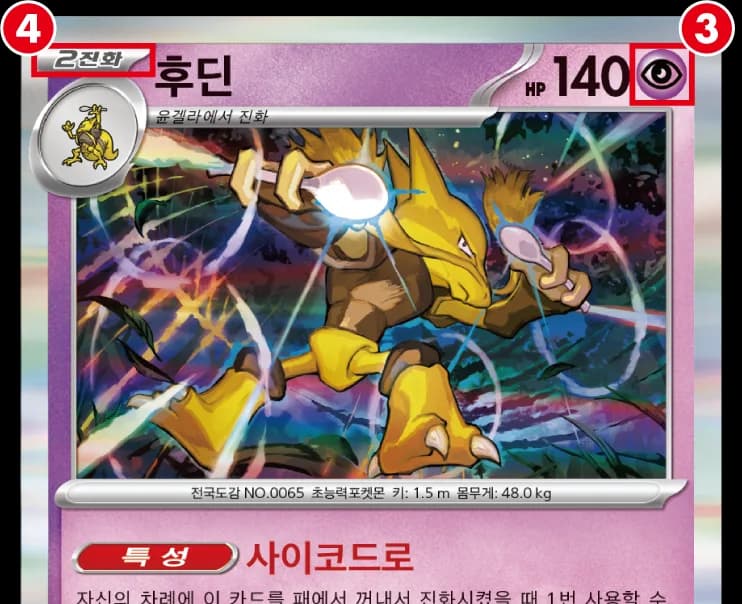
A single Pokémon card contains almost all the numbers needed for a battle. The first things a new player should learn are the HP, Type, Energy marks next to attacks, and the Weakness, Resistance, and Retreat notations. This article is summarized based solely on the 'How to Play' page of the Pokémon Trading Card Game Korea official website and the Japanese official 'Advanced Rule Guide' (ver.3.4). Regulation marks and rarity notations are covered in a separate guide.
HP and Type
HP represents the Pokémon's health. The official explanation states, "If it receives damage equal to this number, it is Knocked Out." In the official website's example, Ralts is Knocked Out if it receives 70 or more damage.
Type is indicated by a mark. According to the official explanation, Type affects "Weakness and Resistance." This mark is used to compare whether your Pokémon's Type matches the Weakness or Resistance Type listed on the opponent's card.
Attacks and Energy Costs
The Energy marks next to the attack name indicate the Energy required to use that attack. In the official website's example, "Power Gem" requires 1 Fighting Energy, and "Mountain Fall" requires 3 Energy regardless of type. The Colorless type mark means it can be filled with Energy of any type. Attacks with no Energy cost listed can be used without any Energy attached.
The number to the right of the attack name is the attack's damage. An attack cannot be used if the required Energy is not attached, and the Energy remains attached even after the attack is used. Attacks can only be used by the Active Pokémon and cannot be used on the first player's first turn. Only one Energy card can be attached from the hand per turn.
Weakness ×2, Resistance −30, Retreat Cost
| Notation | Meaning | Official Example (Ralts) | |---|---|---| | Weakness | Damage from opponents of this type is doubled | 2x damage from Darkness types | | Resistance | Damage from opponents of this type is reduced by the written amount | "-30" damage from Fighting types | | Retreat | Number of Energy to discard when moving to the Bench | Equal to the number of Colorless marks |
If no mark is listed, the card has no Weakness or Resistance. Only the Active Pokémon's damage is modified by Weakness and Resistance. Weakness and Resistance are not calculated when a Benched Pokémon receives damage.
The calculation order is also defined in official documents. First, determine the damage of the attack, then calculate effects on the attacking Pokémon, followed by Weakness, Resistance, and finally effects on the defending Pokémon. Weakness is calculated before Resistance. Following this order, if Ralts is hit by a 60-damage attack from a Darkness type, it becomes 120; if hit by a Fighting type, it becomes 30. If the damage becomes 0 or negative during intermediate calculations, the calculation ends there, and no damage is dealt.
Retreating is the act of switching the Active Pokémon with a Benched Pokémon. Discard Energy from the Active Pokémon equal to the number of Colorless marks next to "Retreat" on the card. The discarded Energy can be of any type. If there are no Colorless marks, the Pokémon can retreat without discarding Energy. Retreating can be done only once during your turn. Even after returning to the Bench, damage counters and remaining Energy stay, but all Special Conditions are removed and other active effects disappear.
Sources
This article was written with the help of AI based on public sources. Responsible: 김태희 기자 AI principles →
This article was machine-translated from Korean with AI. Original →